.png)
Individualized Math Instruction in Palo Alto: What It Looks Like in a Real Classroom

Updated: May 4

A few years ago, a sixth-grader at our school in Palo Alto sat down to take the AMC 8, a math competition designed for eighth-graders. Out of more than 153,000 students worldwide, only a few hundred earned a perfect score. She was one of them. Among the 67,000 girls who took the test that year, only 32 girls anywhere in the world got every question right. She was one of those, too.
We bring this up not to brag, but because parents in Silicon Valley sometimes assume that a small, individualized school can't deliver serious academics. The opposite tends to be true. When math is taught one student at a time, at the pace and depth they are actually ready for, something quietly remarkable happens. Kids who came in convinced they weren't math people start to enjoy it. Kids who were already strong go further than they would have anywhere else.
This is what individualized math instruction looks like in practice.
What a math class actually looks like here
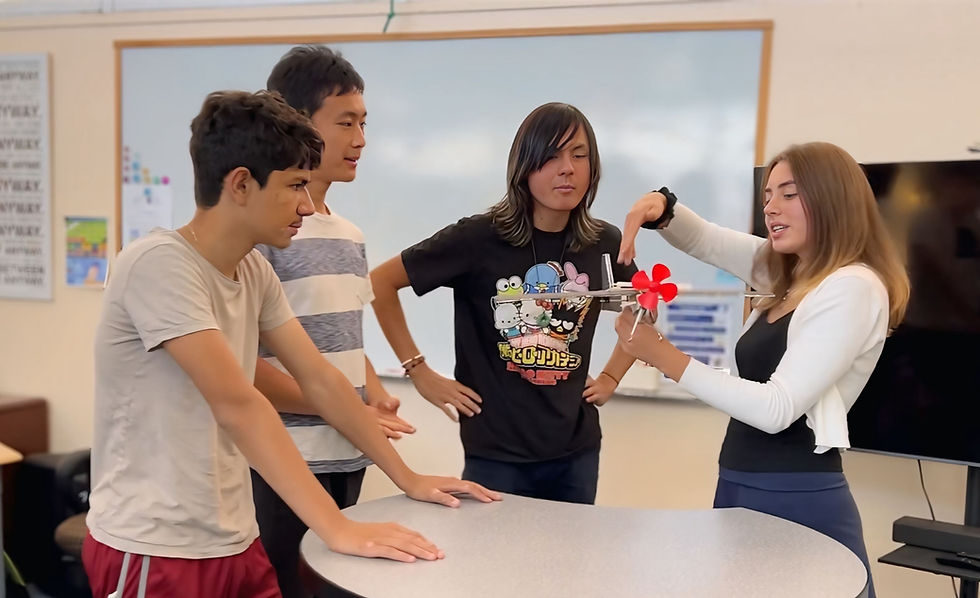
If you walked into our middle school math classroom on a Tuesday morning, here's what you would see. Students working at their own pace, each on a different chapter, sometimes a different textbook. Two teachers in the room at all times. A few students working alone. A few sitting together, one explaining a concept to another. A teacher pulled up next to a student at a small table, walking through a problem the student got wrong on yesterday's test.
"Our program lets each child go through the book at their own pace," says Aryavan McSweeney, our school director and one of our middle school math teachers. "If a student has talent and motivation, they can move as fast as they want, without being held back. If they need more time on a concept, they get it. We're not running a lecture and hoping everyone keeps up. We're tutoring every student, every day.
This is not a lecture-based classroom. There's no teacher at the front of the room presenting today's concept and assigning thirty problems for homework. Instead, every student is on their own trajectory through the material, and the teachers move from student to student, answering questions, checking work, retesting weak spots.
It looks informal. It is anything but.
Why this works for every kind of student
The most common question parents ask us is some version of: Won't this only work for self-motivated kids?
It's a fair question, and the honest answer is that motivation is the teacher's job. We watch each student closely. We keep a math diary that tracks every test, every score, every concept a student is shaky on. If a student goes a few days without finishing a test, we notice immediately, and we know why. Sometimes the student needs a different explanation. Sometimes they need a peer to walk them through it. Sometimes they need a parent at home to set a twenty-minute math time at the kitchen table. We figure it out together.
We've seen this work across the entire range of ability. One year, a student arrived with no confidence in math at all and got zero questions right on the International Math Olympiad. The next year, on the same test, she got 14 out of 25, well above the worldwide average. No tutoring. No special program. Just the regular classroom, where she could move at her own pace, ask for help without embarrassment, and slowly discover that she was, in fact, capable.
In the same classroom, in the same year, students at the other end of the spectrum are taking on advanced material; pre-algebra in fifth grade, algebra in sixth, occasionally calculus by eighth.
What our students go on to do
Many graduates of our program test out of freshman math when they enter high school. Some test out of algebra and geometry. A few test out of trigonometry. They don't do this because we drill them on standardized tests. They do it because by the time they finish eighth grade, they actually understand how math works.
Our alumni have gone on to study at Stanford, UC Berkeley, Cornell, the University of Michigan's Ross School of Business, and graduate programs at universities around the world. The skills that prepare a child for that kind of trajectory — the ability to sit with a hard problem, to think clearly under pressure, to see math not as a wall but as a language — start in classrooms like ours.
For families with younger children curious about how this approach takes root in the earlier years, our elementary and middle school curriculum is where the foundation gets built. By the time students reach our high school curriculum, the habits of focused, independent thinking are already in place.
Why this matters in Silicon Valley specifically
Parents in this area know that math matters. They also know, often from personal experience, that math classrooms can be brutal places. Speed becomes everything. Mistakes are penalized. A child's identity gets quietly shaped by their performance on a timed test. Stanford professor Jo Boaler has written extensively about how this kind of instruction crushes the spirits of students who would otherwise become deep, capable mathematicians.
The alternative isn't softer. In some ways it asks more of students, not less. Our students take the AMC 8 and the International Math Olympiads, challenging timed competitions that demand both speed and creative problem-solving. They do well on these tests. Not because we drill them, but because they've spent years building real fluency. The work is rigorous, and the atmosphere is calm.
This is what we mean by individualized math instruction. It is a serious academic experience that meets each child where they are.
Come see for yourself
The best way to understand how a classroom like this works is to stand in one. We invite parents to visit the school on a regular weekday, not a polished open house but a normal Tuesday, and watch a math class in progress. If you'd like to learn more about applying, our admissions team is happy to walk you through the process.
Math doesn't have to be a source of dread. For the right student in the right classroom, it can become one of the most satisfying things they do all week. Living Wisdom School is an independent K–12 school in Palo Alto, California, rooted in the Education for Life philosophy — educating the whole child, academically and inwardly, since 1992.
Frequently Asked Questions
What is individualized math instruction?
Individualized math instruction means each student works at the pace and depth that matches their actual readiness, rather than all students moving through the same chapter on the same day. At Living Wisdom School, students progress through their math books on their own timeline, with two teachers in the room at all times to provide one-on-one support, retesting, and tutoring as needed.
How do mixed-age math classrooms work?
In our middle school math classroom, sixth, seventh, and eighth graders learn in the same room. This works because instruction is individualized — students aren't competing with their grade level, they're working through their own material. Younger students often benefit from seeing older peers tackle advanced concepts, and older students often deepen their own understanding by helping a younger classmate.
Will my child fall behind without lectures and homework drills?
This is the most common question we get, and the answer is no, provided the classroom has the right structure. Our math diary tracks every test and every concept each student is working on. If a child slows down, we know within days, not months, and we adjust. Most of our graduates test out of freshman math when they enter high school.
Is this approach only good for gifted students?
No. We've seen it work just as powerfully for students who arrive convinced they're "bad at math" as for students who are already advanced. Removing the pressure of keeping up with a class often unlocks confidence in students who had given up on themselves.
Do students at Living Wisdom take standardized math tests?
Our students take the AMC 8 and the International Math Olympiads, among the most challenging math competitions for their age groups, and consistently do well. We don't drill for these tests. We teach our regular curriculum and let students apply what they've learned.